Why Endless Jumping Games Never Get Old: The Design Behind the Climb

Endless jumping games are one of the oldest mobile genres still alive. Doodle Jump arrived in 2009, in the first wave of iPhone games, and the formula it popularized has outlived motion controls, 3D pushes, AR experiments, and several generations of hardware. That is unusual. Most early mobile genres are museum pieces by now.
So why does this one keep working? The answer is not nostalgia. It is a handful of design decisions that happen to fit phones, and human attention, almost perfectly.
What endless jumping games get right
One input, full control
A vertical jumper needs exactly one axis of input: left and right. Tilt the phone or touch a side of the screen. Jumping is automatic. That means the entire game is playable with one thumb, standing on a bus, in the thirty seconds before a meeting starts.
This is not a small thing. Most genres that died on mobile died because they asked for console-style input on a piece of glass. Jumpers never had that problem. The constraint became the identity.
The screen is the level
Phones are tall. Vertical climbers are tall. The genre is one of very few where the shape of the device and the shape of the game are the same shape. Every platform you need to see is on screen, the direction of progress is the direction your eye naturally travels, and nothing important happens off to the sides.
Procedural platforms, infinite runway
Because the level is generated as you climb, there is no content wall. The game never runs out, and no two runs are identical. The designer’s job shifts from building levels to tuning a distribution: how often platforms break, when monsters appear, how far apart safe ground sits at altitude 10,000 versus altitude 500.
Done well, that tuning produces a smooth difficulty ramp that feels fair even when it kills you.
Death is always your fault
In a good jumper you always know why you died. You drifted too far chasing a coin. You bounced onto a platform that visibly cracked. You hesitated. Clear cause and effect is what makes “one more run” feel reasonable instead of frustrating, and it is why people play these games for years.
The part that did get old
Honesty requires admitting where the classic formula has worn thin: the score chase is solitary. A high score is only meaningful if someone sees it, and leaderboards full of strangers stopped motivating most players a decade ago.
The early attempts to fix this were races, where two players climbed for speed rather than survival. We dig into that history in our post on Doodle Jump multiplayer. Races helped, but they changed the genre’s soul: the tension of a climber is not “am I fast,” it is “can I survive what comes next.”
The other worn part is identity. Most jumpers hand you a fixed mascot or sell you skins from a catalog. After a while, every player on the leaderboard looks the same.
Where the genre is heading
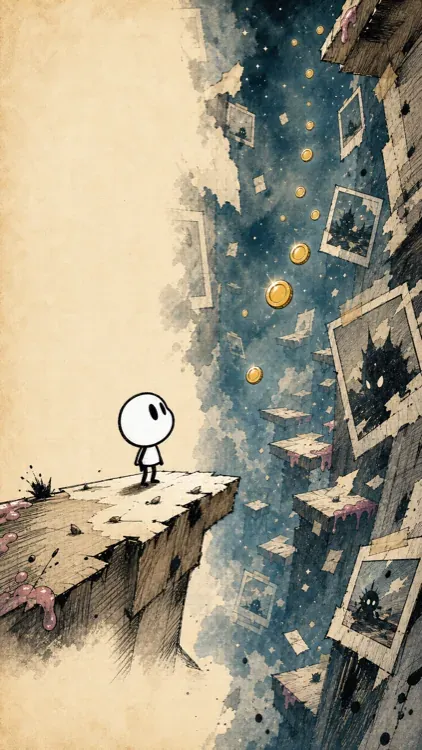
The interesting work in endless jumping games right now is happening on exactly those two weak points.
Shared climbs. Putting multiple players on the same procedural page, with survival rules instead of race rules, keeps the genre’s core tension and adds a social one. When the threat comes from below and only one climber can outlast it, every platform choice doubles as a play against the other players.
Characters you make, not pick. Prompt-based character generation means a player can describe a little climber in a sentence and play as it minutes later. The character becomes theirs in a way no catalog skin can match.
We are building our own answer to both ideas. Inklets is a sketchbook-style, three-player climber where the page floods with ink from below and the last Inklet standing wins, and where your climber starts as a short text description. It is planned for iOS and Android in Summer 2026. If you want to see how the classic formula compares to other takes first, our roundup of games like Doodle Jump covers the field.
The takeaway
Endless jumping games survived because their constraints match the device and the moment: one thumb, one screen, one clear death, one more run. The formula does not need replacing. It needs company on the page. The next decade of the genre will be about who you climb with and who you climb as, and that is a much more interesting question than how high.
Related reads.
 games like doodle jump
 7 Games Like Doodle Jump for Players Who Love Vertical Jumpers
Looking for games like Doodle Jump? Here are seven vertical jumpers worth your time, from genre classics to a new multiplayer climber arriving in 2026.
 doodle jump multiplayer
 Doodle Jump Multiplayer: What Exists, What Doesn't, and What's Next
Can you play Doodle Jump multiplayer with friends? Here is what Lima Sky shipped, why racing isn't the whole answer, and what a survival climber adds.